4.9/5
4.9/5


Napoleon ordered the first picture on this list in 1804, and Monet offered the last to the French state the day after the 1918 armistice. Together, these nine famous French paintings trace French art through the Empire, Romanticism, Impressionism and the first years of modern art. All nine also belong to the wider canon of famous paintings.
They run in date order. Jacques-Louis David's Coronation of Napoleon, Théodore Géricault's Raft of the Medusa and Eugène Delacroix's Liberty Leading the People come first. Claude Monet's Impression, Sunrise, Pierre-Auguste Renoir's Bal du moulin de la Galette, Georges Seurat's La Grande Jatte and Paul Cézanne's Card Players follow. Henri Matisse's Dance and Monet's Water Lilies close the list.
Asked for the single most famous French painting, I would answer with number 3, Liberty Leading the People. The Mona Lisa hangs in Paris too, but Leonardo was Italian, so it sits with the great paintings of Italy. Spain's Velázquez and Goya lead the best-known Spanish paintings.
The nine famous French paintings at a glance
| # | Painting | Artist | Year | Collection |
|---|---|---|---|---|
| 1 |  The Coronation of Napoleon The Coronation of Napoleon | Jacques-Louis David | 1805 to 1807 | Louvre, Paris |
| 2 |  The Raft of the Medusa The Raft of the Medusa | Théodore Géricault | 1818 to 1819 | Louvre, Paris |
| 3 |  Liberty Leading the People Liberty Leading the People | Eugène Delacroix | 1830 | Louvre, Paris |
| 4 |  Impression, Sunrise Impression, Sunrise | Claude Monet | 1872 | Musée Marmottan Monet, Paris |
| 5 |  Bal du moulin de la Galette Bal du moulin de la Galette | Pierre-Auguste Renoir | 1876 | Musée d'Orsay, Paris (on loan to the National Gallery, London, until January 31, 2027) |
| 6 |  A Sunday on La Grande Jatte A Sunday on La Grande Jatte | Georges Seurat | 1884 to 1886 | Art Institute of Chicago |
| 7 |  The Card Players The Card Players | Paul Cézanne | 1890 to 1896 (five versions) | Barnes Foundation, Philadelphia (largest); Musée d'Orsay, Paris (not on view, autumn 2026) |
| 8 | Dance | Henri Matisse | 1909 to 1910 | Hermitage Museum, St. Petersburg; study at MoMA, New York |
| 9 |  Water Lilies Water Lilies | Claude Monet | 1899 to 1926 | Musée de l'Orangerie, Paris; The Water-Lily Pond at the National Gallery, London |
Empire and Romanticism: 1805 to 1830
01The Coronation of Napoleon, David (1805 to 1807)

Zoom
Napoleon ordered this picture in September 1804, three months before he was crowned in Notre-Dame. Jacques-Louis David painted it from late 1805 to late 1807, in a disused chapel near the Sorbonne. One assistant handled the architecture and another the costumes.
The finished coronation canvas is more than six meters tall and nearly ten meters wide. Only one painting in the Louvre is bigger: Veronese's Wedding Feast at Cana. The French call it Le Sacre, the consecration, though the moment it shows is the coronation.
David first painted Napoleon crowning himself. In 1806 he painted that figure out and chose the calmer moment that followed, Napoleon lifting a second crown for Josephine. About 190 figures crowd the scene, and roughly half of them are portraits of known people. David put himself in a gallery, sketching.
Four people in the picture were not in the cathedral that day. One was Napoleon's mother, Laetitia, who was in Rome; the Louvre's catalogue entry for Le Sacre names the other three. When Napoleon saw the canvas in 1808, his one request was to raise the pope's right hand into a blessing.
The picture hung at Versailles from 1837 to 1889 and has been at the Louvre since 1890. David died in Brussels in 1825. His road from the Revolution to the Empire runs through twelve of his key paintings.
02The Raft of the Medusa, Géricault (1818 to 1819)

Zoom
In July 1816 the French frigate Méduse, bound for Senegal, ran aground on the Arguin Bank off the West African coast. About 150 people were put on a raft built from the wreck, and the ropes that tied it to the ship's boats were cut. When the brig Argus found the raft about two weeks later, 15 of them were still alive.
Two survivors, the ship's surgeon Savigny and the geographer Corréard, published their account in 1817. Théodore Géricault worked from it and talked with both men. He chose a moment of false hope, with the men waving at a ship that has not seen them. Rescue came only two hours later.
At the Salon of 1819 the picture hung under the neutral title Scene of a Shipwreck and won a gold medal. No sale to the state went through in the painter's lifetime. Géricault died in 1824, and at the estate sale that year a friend bid for the shipwreck canvas on behalf of the director of the royal museums. Almost five meters tall and more than seven meters wide, it has been on view at the Louvre since 1826, except in wartime.
In 1859 and 1860 the Louvre took the painting down so that two painters, Eugène Ronjat and Pierre Désiré Guillemet, could copy it at full size. Their copy is now in the Musée de Picardie in Amiens. Liberty Leading the People usually hangs in the same room, the Salle Mollien, and fifteen Louvre paintings beyond the Mona Lisa make a good next stop.
03Liberty Leading the People, Delacroix (1830)

Zoom
Hand-painted oil reproductionSee sizes ›
Eugène Delacroix painted this barricade in the autumn of 1830, in a studio he rented on the quai Voltaire. Its official title, The 28th of July 1830, ties it to the second of three days of street fighting in Paris that brought down Charles X. It is the July Revolution, not the Revolution of 1789.
“I have undertaken a modern subject, a barricade, and if I have not won victory for my country, at least I shall paint for her.”
Delacroix filled the crowd with social types. The Louvre's teaching guide reads the man in the top hat as an artisan and the kneeling man as a building worker up from the countryside. In the boy with a pistol in each hand, it sees the figure Victor Hugo would turn into Gavroche in Les Misérables. Delacroix also borrowed from Géricault: the bodies in the foreground and the pyramid of figures come from the Raft.
The state bought the barricade picture in 1831 and showed it at the Musée du Luxembourg in 1832 and 1833. Then it was put in storage, and around 1839 it returned to Delacroix. He kept it at his aunt's house in Frépillon, north of Paris. It reached the Louvre in 1874 and was cleaned there in 2023 and 2024.
Over the years its subject became an emblem of the Republic, reused by artists, the press and advertisers. That long afterlife is the best case for calling it the most famous French painting.
The original and our hand-painted copy
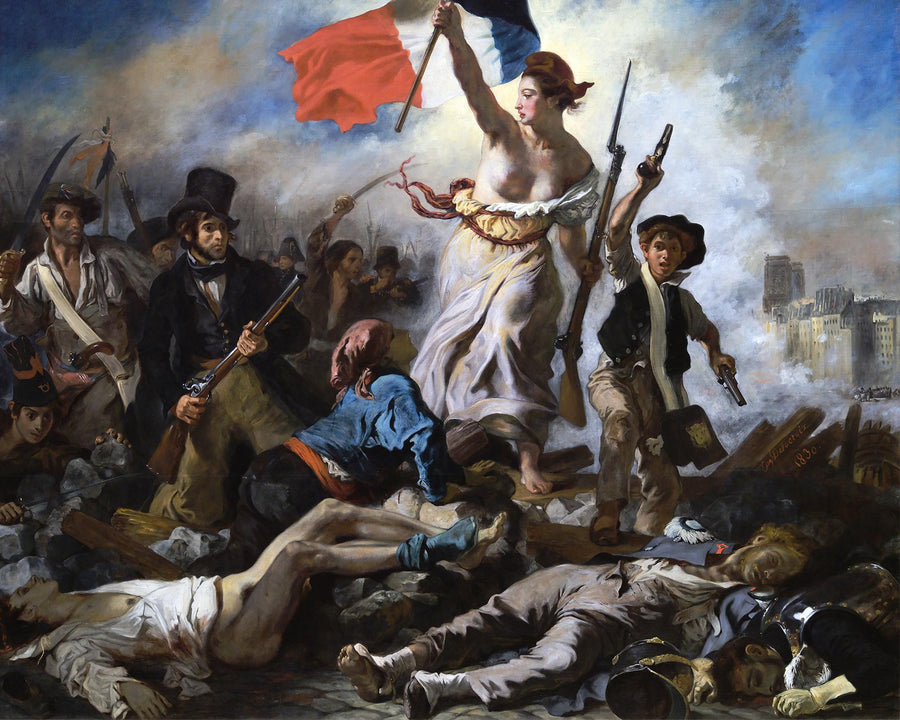
The original
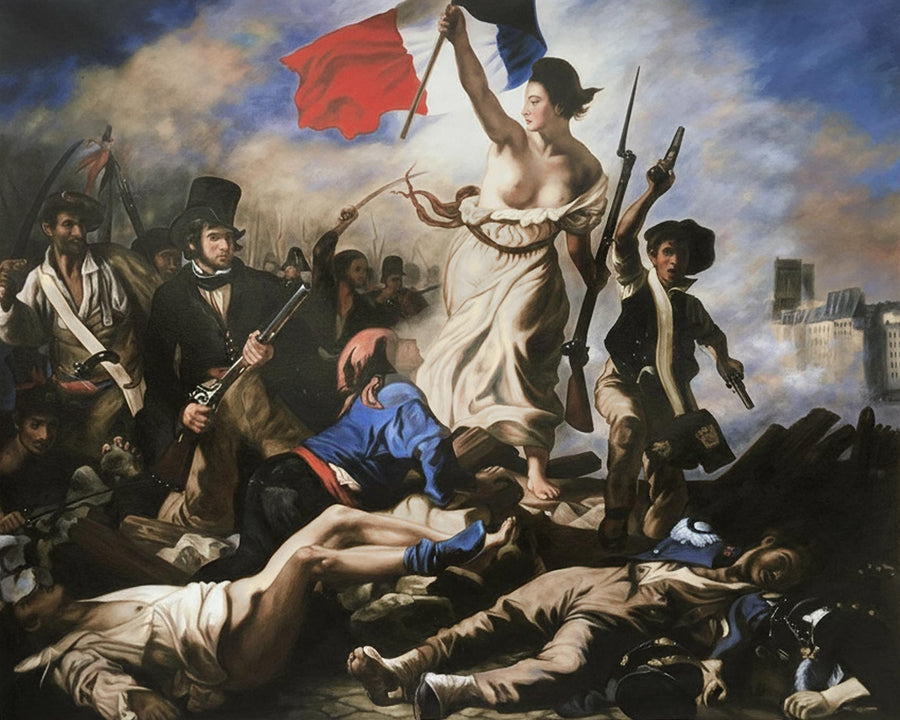
Our reproduction, painted by hand in oil
Impressionism and after: 1872 to 1896
04Impression, Sunrise, Monet (1872)

Zoom
Hand-painted oil reproductionSee sizes ›
Claude Monet painted his view of Le Havre's outer harbor around November 1872, from his window at the Hôtel Amirauté. He worked early in the morning and needed only a few hours. The rowboats in front and the orange sun with its reflection went on last.
In 1874 Monet sent it to the group's first exhibition, held in the photographer Nadar's former studio. Asked for a catalogue title, he knew it could not pass for a proper view of Le Havre, so he called it Impression. That April, Louis Leroy of the satirical paper Le Charivari titled his biting review "The Exhibition of the Impressionists," after that word. A few days later the critic Jules Castagnary used "Impressionists" as praise, and the name stuck.
The canvas has belonged to the Musée Marmottan Monet since 1940, a gift from Eugène and Victorine Donop de Monchy. The Marmottan's entry for the sunrise canvas has the full story of the title. How Monet became the father of Impressionism carries on from there, through eight of his paintings.
05Bal du moulin de la Galette, Renoir (1876)

Zoom
Hand-painted oil reproductionSee sizes ›
Pierre-Auguste Renoir signed and dated his Sunday dance in Montmartre as "Renoir 76" and showed it at the third Impressionist exhibition in 1877. His fellow painter Gustave Caillebotte owned it by 1879.
Caillebotte left his collection to the state, and the bequest was accepted in 1896. The picture went to the Musée du Luxembourg, then to the Louvre, and in 1986 to the Musée d'Orsay.
In October 2026 the painting is away from Paris. It hangs in London until January 31, 2027, in Renoir and Love at the National Gallery, its first showing in the UK. For the Impressionists who stayed in Paris, take a room-by-room walk through the Orsay.
06A Sunday on La Grande Jatte, Seurat (1884 to 1886)

Zoom
Hand-painted oil reproductionSee sizes ›
Georges Seurat began his island Sunday in 1884, after many painted and drawn sketches. Two years later he went back to it, enlarged some silhouettes and added figures such as the monkey on a leash. The painted border came in 1888 and 1889.
Seurat wanted a picture of modern life with the order of a classical Greek frieze. The canvas is more than three meters wide. It was first shown at the eighth Impressionist exhibition, which opened in May 1886.
Frederic Clay Bartlett and Helen Birch Bartlett bought it in 1924 and gave it to the Art Institute of Chicago in 1926. It belongs to the Helen Birch Bartlett Memorial Collection, and in October 2026 it was on view in the Art Institute's Gallery 240.
Film fans know it from Ferris Bueller's Day Off, where Cameron stares into it. Do what Cameron does and walk up until the people dissolve into dots and dashes of complementary color. Then step back and watch them come together.
07The Card Players, Cézanne (1890 to 1896)

Zoom
Hand-painted oil reproductionSee sizes ›
For much of the 1890s Paul Cézanne lived on his father's estate at Aix-en-Provence and painted the men who worked there. Five of his canvases show them playing cards.
The largest is the Barnes Foundation's version, painted from 1890 to 1892. At nearly two meters wide, it is a size usually kept for history or myth.
The Musée d'Orsay's version is much smaller and was painted between 1893 and 1896. Count Isaac de Camondo left it to the national museums in 1911. It was not on view at the Orsay in September and October 2026.
Another canvas from the series changed hands in 2011. The royal family of Qatar bought it from the collection of the Greek shipping magnate George Embiricos, for a reported $250 million. Hyperallergic, following a report in Vanity Fair, called it the world's most expensive painting when the sale became known in 2012.
Into the 20th century: 1909 to 1927
08Dance, Matisse (1909 to 1910)

Zoom
In 1909 the Russian collector Sergei Shchukin commissioned two large panels from Henri Matisse, Dance and Music. Dance was meant for the landing of the staircase in his house. Both were finished in 1910 and now belong to the Hermitage Museum in St. Petersburg.
Matisse first painted a full-size study, Dance (I), quickly in early 1909. It is almost four meters wide and uses only four colors: blue for the sky, green for the ground, and black and pale pink for the five figures.
Critics at the time attacked its simplified bodies as inept or willfully crude, while Matisse felt it evoked "life and rhythm." Nelson A. Rockefeller gave the study to New York's Museum of Modern Art in 1963, in honor of Alfred H. Barr Jr.
09Water Lilies, Monet (1899 to 1926)
In 1893 Monet bought a plot of land next to his house at Giverny. He enlarged its pond, filled it with new hybrid water lilies and built a humpback bridge inspired by Japanese prints. He painted that water garden some 250 times.
The bridge appears in three views of 1895, and Monet came back to it in 1899. The National Gallery in London owns one of that year's views, Monet's Water-Lily Pond. Every later return to the motif is traced in the full run of Japanese bridge paintings.
The original and our hand-painted copy
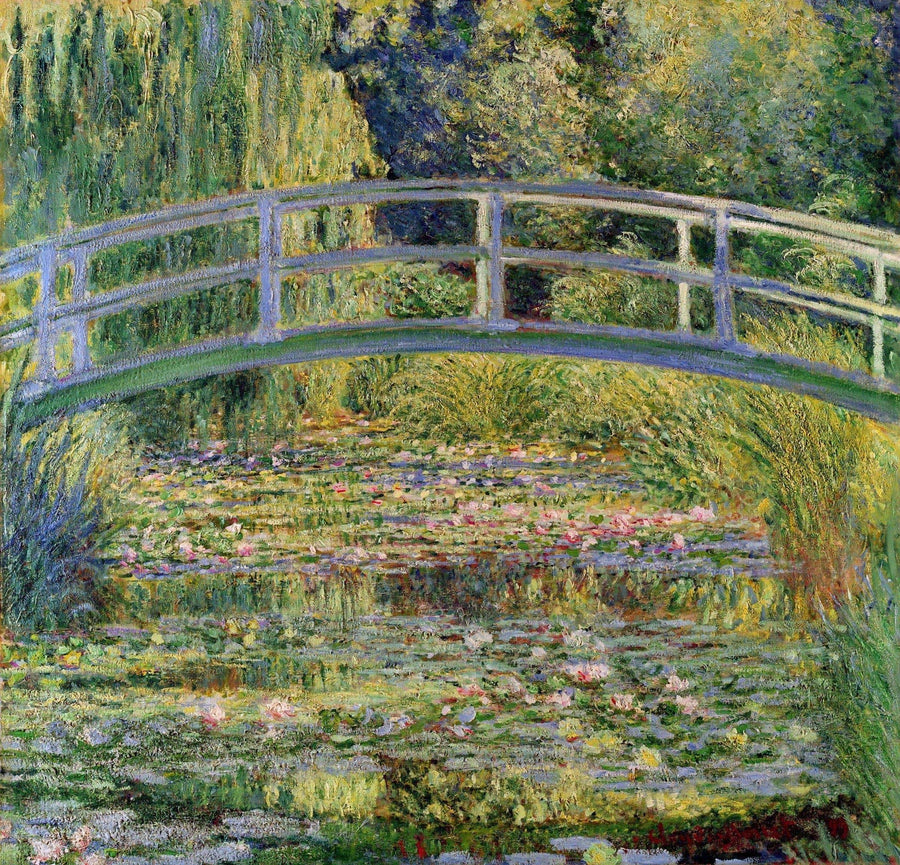
The original
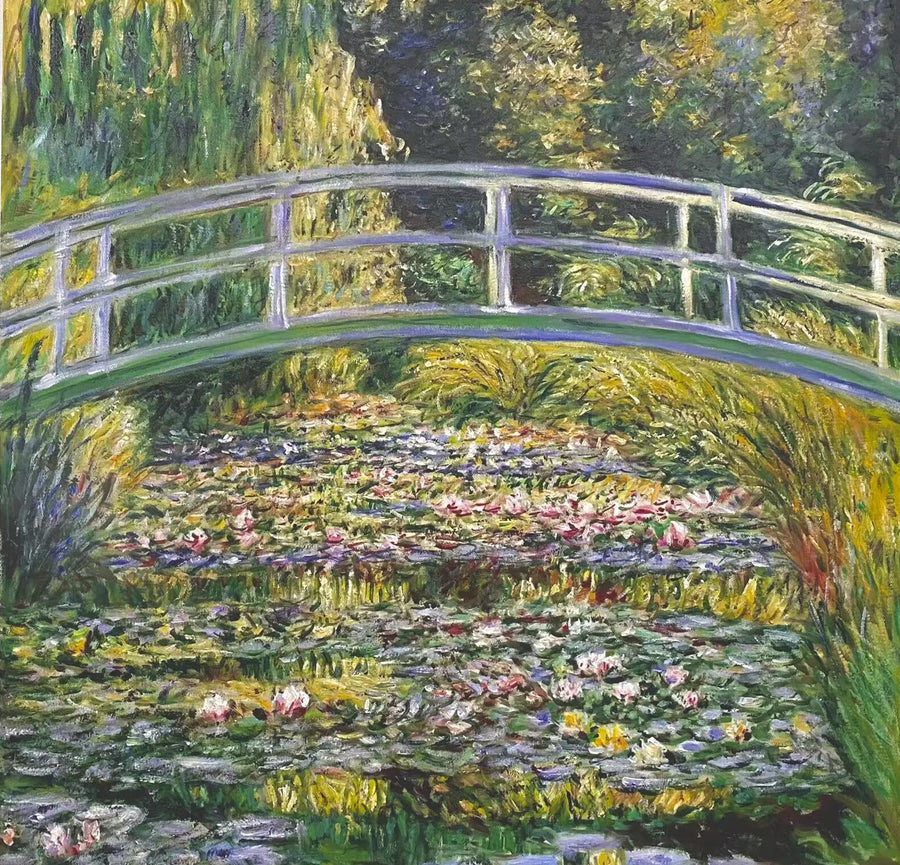
Our reproduction, painted by hand in oil
From the end of the 1890s the pond was his main subject, and the cycle ends in Paris. The day after the armistice of November 11, 1918, Monet offered the state two large panels as a symbol of peace. Prime Minister Georges Clemenceau suggested the Orangerie in the Tuileries garden, and the gift was formalized in 1922.
Monet planned the rooms with the architect Camille Lefèvre. The result is eight compositions in two oval rooms, lit from above. Each composition is two meters high, and together they run 91 meters. Clemenceau opened the rooms in May 1927, a few months after Monet's death.
Ten French painters to know
Add Édouard Manet and Edgar Degas to the eight painters above and you have ten names. Together they cover French painting from Napoleon to the 1920s: David, Géricault, Delacroix, Manet, Monet, Degas, Renoir, Seurat, Cézanne and Matisse.
More famous French paintings to know start with Manet's Olympia and Degas's ballet scenes. Caillebotte, the collector who bought Renoir's dance, painted Paris Street; Rainy Day in 1877, and it belongs to the Art Institute of Chicago. To meet the wider Impressionist circle, start with thirteen Impressionists and one painting each.
From an emperor's order to a collector's staircase
The first canvas here was ordered by an emperor, and the next ones were built for the official Salon. By the end, French painters were showing at independent exhibitions, selling through dealers and painting panels for a private staircase. Several of the nine, from David's coronation to Monet's harbor at dawn, are among our oil copies of famous paintings.
Sources
- Louvre, Le Couronnement de l'empereur Napoléon Ier (collection record)
- Louvre, Le radeau de la Méduse (collection record)
- Britannica, The Raft of the Medusa
- Royal Museums Greenwich, The Raft of the Medusa (print record with the history of the wreck)
- Louvre, Le 28 juillet 1830. La Liberté guidant le peuple (collection record)
- Louvre, La Liberté guidant le peuple, teaching guide (PDF, in French)
- Musée Marmottan Monet, Impression, soleil levant
- Musée d'Orsay, Bal du moulin de la Galette
- National Gallery, London, Renoir and Love (press release, 3 October 2026 to 31 January 2027)
- Art Institute of Chicago, A Sunday on La Grande Jatte, 1884
- Barnes Foundation, The Card Players (Les Joueurs de cartes)
- Musée d'Orsay, Les Joueurs de cartes
- Hyperallergic, Qatar buys Cézanne's The Card Players (2012)
- Museum of Modern Art, Henri Matisse, Dance (I)
- National Gallery, London, Claude Monet, The Water-Lily Pond
- Musée de l'Orangerie, The Water Lilies by Claude Monet
- Musée de l'Orangerie, From the orangerie to the museum
- Art Institute of Chicago, Paris Street; Rainy Day