4.9/5
4.9/5


Giotto painted every wall of a family chapel in Padua between 1303 and 1305. In 1910 Umberto Boccioni painted giant draft horses straining through the building sites of a growing Milan. The ten famous Italian paintings below fall between those two dates, from Botticelli's Venus and the Mona Lisa to Caravaggio, Artemisia Gentileschi, Canaletto and Hayez. For other countries and periods, browse our gallery of famous paintings.
The Renaissance has its own list, twelve paintings from Masaccio to Titian. It includes The Last Supper, The School of Athens and Titian's Venus of Urbino. For France and Spain, see nine French masterpieces and their stories or the great Spanish paintings from El Greco to Picasso.
At a glance
| # | Painting | Artist | Year | Where to see it (October 2026) |
|---|---|---|---|---|
| 1 | Lamentation (The Mourning of Christ) | Giotto | 1303 to 1305 | Scrovegni Chapel, Padua |
| 2 | The Birth of Venus | Sandro Botticelli | About 1485 | Uffizi, Florence |
| 3 |  Mona Lisa Mona Lisa | Leonardo da Vinci | 1503 to 1519 | Louvre, Paris |
| 4 | The Creation of Adam | Michelangelo | 1508 to 1512 | Sistine Chapel, Vatican City |
| 5 |  The Wedding Feast at Cana The Wedding Feast at Cana | Paolo Veronese | 1562 to 1563 | Louvre, Paris |
| 6 |  The Calling of Saint Matthew The Calling of Saint Matthew | Caravaggio | 1599 to 1600 | San Luigi dei Francesi, Rome |
| 7 |  Judith Beheading Holofernes Judith Beheading Holofernes | Artemisia Gentileschi | About 1620 | Uffizi, Florence |
| 8 |  The Stonemason's Yard The Stonemason's Yard | Canaletto | About 1725 | National Gallery, London |
| 9 |  The Kiss The Kiss | Francesco Hayez | 1859 | Pinacoteca di Brera, Milan |
| 10 |  The City Rises The City Rises | Umberto Boccioni | 1910 | MoMA, New York (not on view) |
From Giotto to the High Renaissance: 1303 to 1519
01Lamentation (The Mourning of Christ), Giotto (1303 to 1305)

Zoom
For almost seven centuries Giotto has been revered as the father of European painting. Enrico degli Scrovegni commissioned the chapel in Padua, and Giotto covered the whole interior with frescoes in about two years. The chapel stood against the Scrovegni family palace, which followed the oval outline of a Roman arena, so it is also called the Arena Chapel. It was consecrated in March 1305.
The Lamentation is one of the scenes from the life and Passion of Christ that run in tiers along the side walls. A huge Last Judgment covers the wall opposite the altar.
Two mourners sit with their backs to us, so we join the circle around the body. A bare rock ridge slopes down toward the two faces, Mary's and her son's. A disciple bends forward and flings his arms back, and some of the angels above cover their faces.
Giotto's sense of space and depth came about a century before Renaissance artists turned perspective into theory. The frescoes joined the UNESCO World Heritage List in 2021. To protect them, visitors now wait in an air-conditioned room before going in. Giotto appears beside Cimabue and Duccio among eight landmarks of Gothic painting.
02The Birth of Venus, Botticelli (about 1485)

Zoom
In The Birth of Venus, Sandro Botticelli shows the goddess just after her birth from the sea spray. The winds Zephyr and, perhaps, Aura blow her scallop shell ashore at Cyprus. A young woman, possibly one of the Graces or the Hora of spring, holds out a cloak covered in flowers.
Botticelli painted it in tempera on canvas and gilded the highlights in her long blond hair. Her modest pose comes from classical statues, and the two Winds copy a Hellenistic carved gem that belonged to Lorenzo the Magnificent. The poet Agnolo Poliziano may have suggested the subject.
A member of the Medici family probably commissioned it, though nothing written about the painting survives from before 1550. That year Giorgio Vasari described it in the Medici villa at Castello. The orange trees fit the theory, because oranges were then called mala medica, which echoed the family name. In October 2026 it was on view in room A12 of the Uffizi in Florence.
03Mona Lisa, Leonardo da Vinci (1503 to 1519)
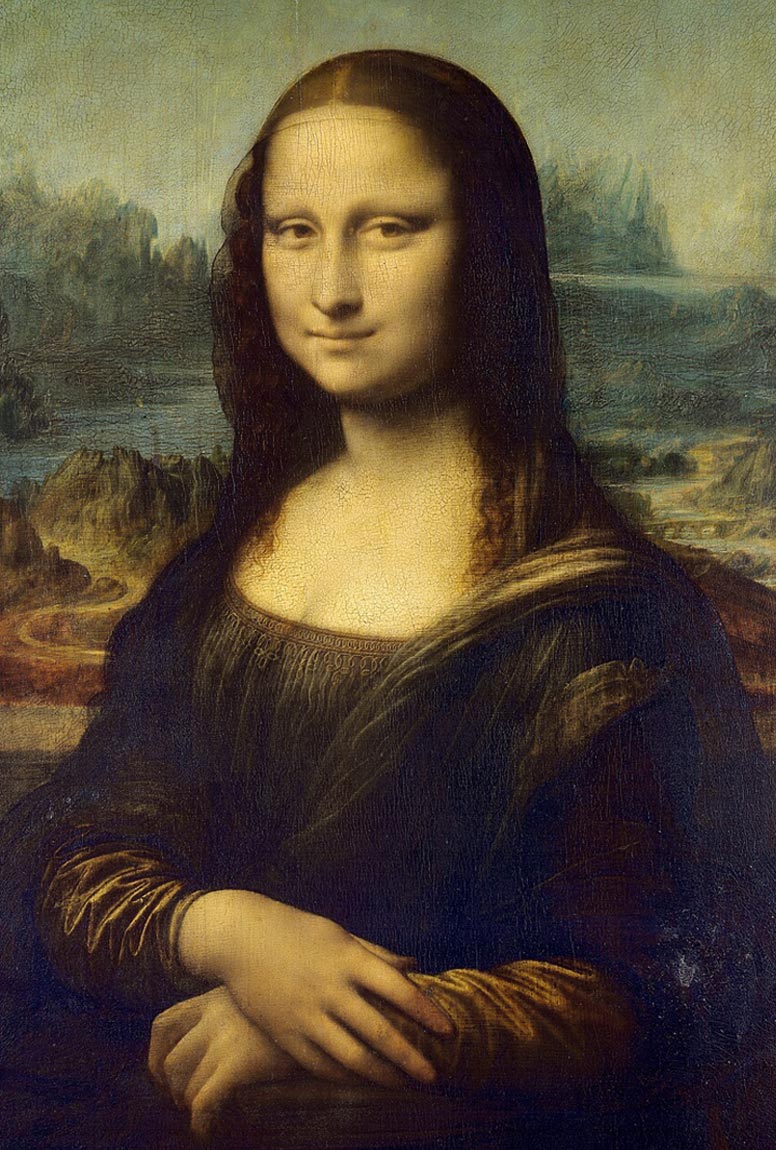
Britannica calls the Mona Lisa "probably the world's most famous painting," the closest thing to an answer for the most famous painting of all time. It portrays Lisa Gherardini, who married the Florentine silk merchant Francesco del Giocondo in 1495. Leonardo painted her in oil on a thin poplar panel.
Proof that Leonardo had started by 1503 turned up in a Heidelberg library in 2005. In October 1503 Agostino Vespucci, who worked with Machiavelli in Florence's chancery, wrote a note in the margin of a book. He compared Leonardo to the ancient painter Apelles, who left a Venus unfinished, and gave the head of Lisa del Giocondo as his example.
The original and our hand-painted copy
The original
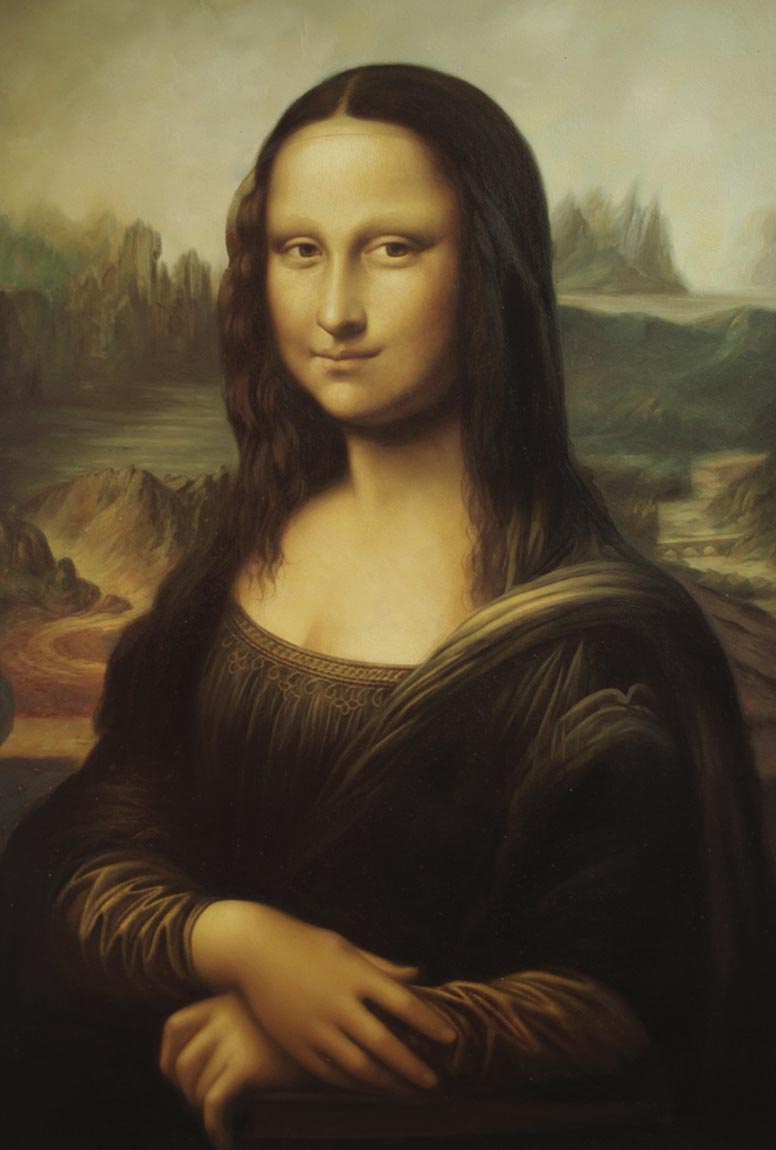
Our reproduction, painted by hand in oil
Leonardo kept the panel until he died, still working on it. In 1999 the historian Bertrand Jestaz found a 1518 payment from King Francis I to Salaì, Leonardo's pupil, for paintings given to the king. On that evidence, the Louvre's catalogue entry on the portrait concludes that Francis very probably acquired it that year. Thick varnish added after Leonardo's death has yellowed, and it now turns the blue of the sky green.
Where is the Mona Lisa kept today? As of autumn 2026 it hangs in Room 711, the Salle des États, on Level 1 of the Louvre's Denon wing. It has hung in that room since 1966, and since 2005 it has sat in a glass case that controls temperature and humidity.
The Louvre Nouvelle Renaissance project includes a new space designed for this painting alone. To see how it compares with other icons, try the world's 30 best-known paintings, ranked.
04The Creation of Adam, Michelangelo (1508 to 1512)

Zoom
The Sistine ceiling began as a repair job. After a long crack opened in the vault in May 1504, Pope Julius II decided to have it repainted. Michelangelo signed a contract in May 1508 for twelve apostles and ornament. He considered that plan "a poor thing," and the pope let him design the whole program instead.
The result was nine stories from Genesis along the center of the vault. Michelangelo had painted half of it, from the entrance end as far as the Creation of Eve, by August 1510. The Creation of Adam, the next scene toward the altar and the fourth of the nine, belongs to the second campaign.
The vault was complete by the end of October 1512, and the pope said Mass in the chapel on November 1. Look at the gap between the hands: Adam's hangs slack while God's index finger strains toward it. His other paintings are few, and you can find them in Michelangelo's small body of paintings.
Venice, Caravaggio and Artemisia: 1562 to 1620
05The Wedding Feast at Cana, Paolo Veronese (1562 to 1563)

Zoom
Paolo Veronese painted The Wedding Feast at Cana in 1562 and 1563 for the dining hall of the Benedictine monastery of San Giorgio Maggiore in Venice. He set the miracle at Cana inside a Venetian banquet of his own day, with well over a hundred guests. It is the largest painting in the Louvre, and it faces the Mona Lisa across the Salle des États.
Napoleon's troops seized it in 1797, rolled up the huge canvas and shipped it to Paris, where it arrived in 1798. It had to be moved twice more, in 1870 and 1939, when Paris was at war. Veronese's Venetian banquet is also on our list of Louvre highlights beyond the Mona Lisa.
06The Calling of Saint Matthew, Caravaggio (1599 to 1600)

Zoom
Caravaggio's Calling of Saint Matthew belongs to his first important public commission. He painted three large canvases on the life of Saint Matthew for the Contarelli Chapel in San Luigi dei Francesi in Rome. This one still hangs in that chapel. The subject is Jesus calling Levi, a tax collector who became the apostle Matthew, at his tax booth.
Caravaggio staged sacred stories as if they were happening in his own day, often painting live models in modern dress. Here Matthew, a well-dressed tax collector, sits with armed companions around a table of coins. Christ points at him from the right, and Matthew points at himself.
Christ's gesture is borrowed from Adam's hand on the Sistine ceiling. Light falls from the upper right into the dark room, a sharp contrast of light and shadow called tenebrism. Christ's halo is only a thin gold band, easy to miss, and one of the men counting money wears eyeglasses. For his other famous canvases, see where to find each major Caravaggio.
07Judith Beheading Holofernes, Artemisia Gentileschi (about 1620)
Artemisia Gentileschi's Judith Beheading Holofernes shows the killing itself. Judith holds the Assyrian general by the hair as the sword goes into his neck. His blood spurts far enough to stain her breast.
She finished it in Rome around 1620, after seven years in Florence, and there she could study Caravaggio's work again. Florence did not welcome the result. Its raw realism provoked strong reactions when it arrived, and it was refused a place in the Gallery.
Grand Duke Cosimo II de' Medici, who had agreed the fee, died in 1621. Artemisia was paid only much later, with help from her friend Galileo Galilei.
She worked for the courts of Rome, Florence and Naples and traveled to England. She also became the first woman in Florence's Accademia delle Arti del Disegno. In October 2026 it hung in room D29 of the Uffizi, which pairs Artemisia with Caravaggio. Her story continues among twenty women painters from Artemisia to O'Keeffe.
Venice, Milan and the modern city: about 1725 to 1910
08The Stonemason's Yard, Canaletto (about 1725)

Zoom
Hand-painted oil reproductionSee sizes ›
In The Stonemason's Yard, Canaletto shows a working corner of Venice in about 1725. Its official title, Venice: Campo S. Vidal and Santa Maria della Carità, names the square and the church across the water. The square had become a temporary mason's yard while the nearby church of San Vidal was repaired.
Early morning sun falls on the people around the stone. A mother rushes to a child who has fallen over, watched by her daughter and by a neighbor at an upstairs window. A woman spins on a balcony, and another draws water from a well that still stands in the square.
Across the Grand Canal is the church of Santa Maria della Carità, whose bell tower collapsed in 1744 and was never rebuilt. Sir George Beaumont gave the picture in 1823, and it passed to the National Gallery in 1828 as the first Canaletto in the collection. It hangs in Room 33 in London (October 2026). The National Gallery's page on the Campo San Vidal view includes an audio description of the scene.
09The Kiss, Francesco Hayez (1859)

Zoom
Hand-painted oil reproductionSee sizes ›
Hayez's Kiss is one of the most famous Italian paintings of the 1800s and a symbol of the Pinacoteca di Brera in Milan. Its full title is The Kiss. Episode of Youth. Costumes of the Fourteenth Century. Brera owns the first version, painted in 1859 and given by the man who commissioned it, Alfonso Maria Visconti di Saliceto. Hayez repeated the subject several times.
In 1859 the troops of Victor Emmanuel II of Sardinia, allied with Napoleon III's French army, defeated the Austrian army and entered Milan. Italian unification was proclaimed in 1861. Brera's description of the painting for Room 38 reads the medieval couple as a patriot volunteer taking leave of his sweetheart.
Her blue dress, his red hose and green jacket join the colors of the French and Italian flags. Hayez (1791 to 1882) was born in Venice, taught at the Brera Academy in Milan and was the leading painter of historical Romanticism in Italy. Brera shows The Kiss in Room 38 (October 2026).
10The City Rises, Umberto Boccioni (1910)

Zoom
Hand-painted oil reproductionSee sizes ›
Umberto Boccioni, leader of the Italian Futurists, painted The City Rises in 1910 as a celebration of industrial Milan. Futurists praised machines, yet he gave the energy of the growing city to immense draft horses, with men straining beside them. Only in the background can you make out a puffing locomotive and a streetcar.
The broken color comes from the divisionism of Giovanni Segantini, but Boccioni tore its dots into ribbons. He painted the canvas before his first trip to Paris in 1911, so Cubism had not yet entered his work.
The picture toured Europe with the Futurist exhibition of 1912 and 1913. The pianist and composer Ferruccio Busoni, who lived in Berlin, bought it in 1912. The Museum of Modern Art bought it from his son in 1951 with the Mrs. Simon Guggenheim Fund. It was not on view at MoMA in October 2026, so check before you go.
Four famous Italian artists
Who are four famous Italian artists? The quickest answer comes from the Teenage Mutant Ninja Turtles, who were named for the Renaissance artists Leonardo, Michelangelo, Raphael and Donatello. Two of them, Leonardo and Michelangelo, have paintings above. For painting outside the Renaissance, add Giotto for the years before it, Caravaggio for the Baroque and Hayez for the 1800s.
Seeing famous Italian paintings where they were made
Giotto's chapel, Michelangelo's vault and Caravaggio's side chapel still hold the works made for them. A trip to Padua and Rome shows those three exactly where their painters meant them to be seen. The other seven now hang in museums. The Mona Lisa, Hayez's Kiss and Canaletto's Venetian square are among the famous paintings our studio artists reproduce by hand in oil.
Sources
- Cappella degli Scrovegni, official site (Padua)
- Cappella degli Scrovegni, The Scrovegni Chapel
- Britannica, Arena Chapel
- Britannica, Giotto
- Uffizi Galleries, Birth of Venus
- Louvre, Portrait of Lisa Gherardini (Mona Lisa), collection record
- Britannica, Mona Lisa
- Louvre, A superstar and a wedding crowd (Room 711)
- Louvre, Louvre Nouvelle Renaissance architecture competition
- Vatican Museums, Sistine Chapel: the Ceiling
- Vatican Museums, Sistine Chapel ceiling: the Central Stories
- Louvre, The Wedding Feast at Cana, collection record
- Louvre, From the Mona Lisa to The Wedding Feast at Cana
- Smarthistory (Beth Harris and Steven Zucker), Caravaggio's Calling of St. Matthew, via Lumen Learning
- Utah Valley University, Art History: Caravaggio, The Calling of St. Matthew
- Britannica, Caravaggio
- Uffizi Galleries, Judith Beheading Holofernes
- National Gallery, Canaletto, Venice: Campo S. Vidal and Santa Maria della Carità (The Stonemason's Yard)
- Pinacoteca di Brera, Il Bacio di Francesco Hayez (Room 38 description)
- MoMA, Umberto Boccioni, The City Rises
- MoMA, press release on the Mrs. Simon Guggenheim Fund exhibition (1952)
- Britannica, Teenage Mutant Ninja Turtles